Sijie Zhao
Ph.D. Candidate, The University of Tokyo (2026)
I am Sijie Zhao. I received my M.S. degree from Nanjing University, where I worked under the supervision of Prof. Xueliang Zhang and Prof. Pengfeng Xiao. I will join the University of Tokyo as a Ph.D. student, advised by Prof. Naoto Yokoya. My current research interests include remote sensing agents, geospatial reasoning, disaster remote sensing, and Earth observation. Feel free to send me an email if you would like to chat with me for any reason.
The University of Tokyo
Ph.D. in Department of Complexity Science and Engineering (Supervised by Prof. Naoto Yokoya) Oct. 2026 - Now
Nanjing University
M.S. in School of Geography and Ocean Science (Supervised by Prof. Xueliang Zhang and Prof. Pengfeng Xiao) Sep. 2023 - Jul. 2026
Nanjing University
B.S. in School of Geography and Ocean Science Sep. 2019 - Jul. 2023
Sijie Zhao*, Feng Liu*, Xueliang Zhang†, Hao Chen†, Xinyu Gu, Zhe Jiang, Fenghua Ling, Ben Fei, Wenlong Zhang, Junjue Wang, Weihao Xuan, Pengfeng Xiao, Naoto Yokoya, Lei Bai(† corresponding author)
arXiv 2026 Preprint
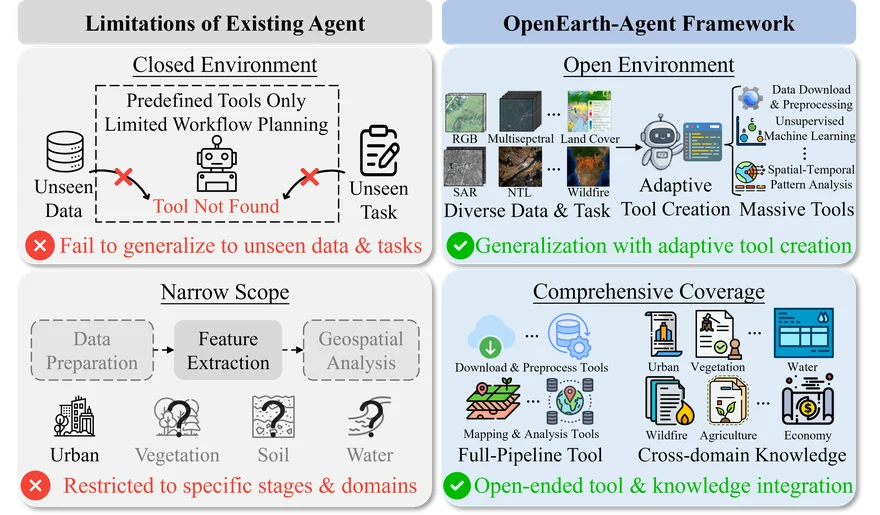
OpenEarth-Agent is a tool-creation agent framework for open-environment Earth Observation, designed to handle diverse multi-source data and heterogeneous tasks beyond the limits of closed, predefined tool-calling systems. It adaptively plans workflows, creates task-specific tools, integrates multi-stage tools and cross-domain knowledge, and is evaluated with OpenEarth-Bench, demonstrating robust full-pipeline EO performance across multiple application domains.
Sijie Zhao, Feng Liu, Xueliang Zhang†, Hao Chen†, Tao Han, Junchao Gong, Ran Tao, Pengfeng Xiao, Xinyu Gu, Lei Bai, Wanli Ouyang(† corresponding author)
ICML Oral 2026 Conference
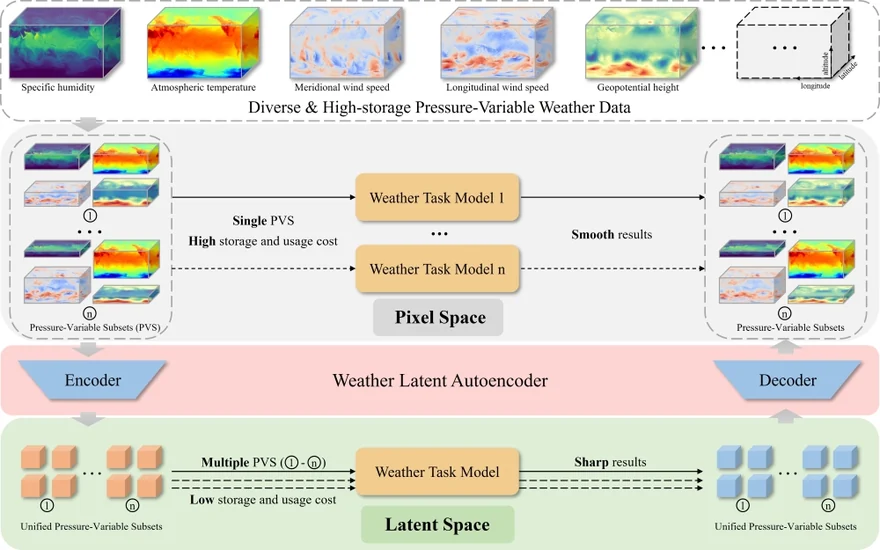
This research introduces WLA, a novel deep learning model that compresses massive weather datasets into a compact latent space. This innovation significantly reduces data storage and computational costs, while improving the accuracy and adaptability of weather task models across diverse scenarios.
Sijie Zhao, Feng Liu, Xueliang Zhang†, Hao Chen†, Pengfeng Xiao, Lei Bai(† corresponding author)
arXiv 2025 PrePrint
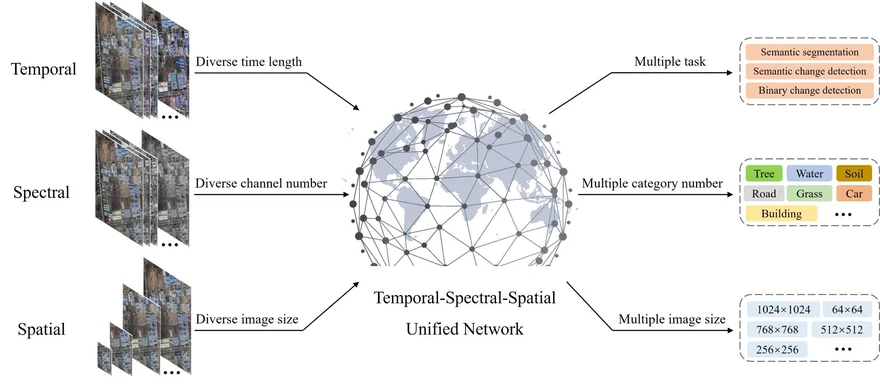
This research introduces TSSUN, a novel deep learning model that unifies diverse remote sensing data and dense prediction tasks. It addresses data heterogeneity challenges by standardizing input/output, achieving state-of-the-art performance across various applications without task-specific modifications.
Sijie Zhao, Hao Chen†, Xueliang Zhang†, Pengfeng Xiao, Lei Bai, Wanli Ouyang(† corresponding author)
IEEE Transactions on Geoscience and Remote Sensing (TGRS, SCI Q1 TOP, IF=8.3) 2025 Journal
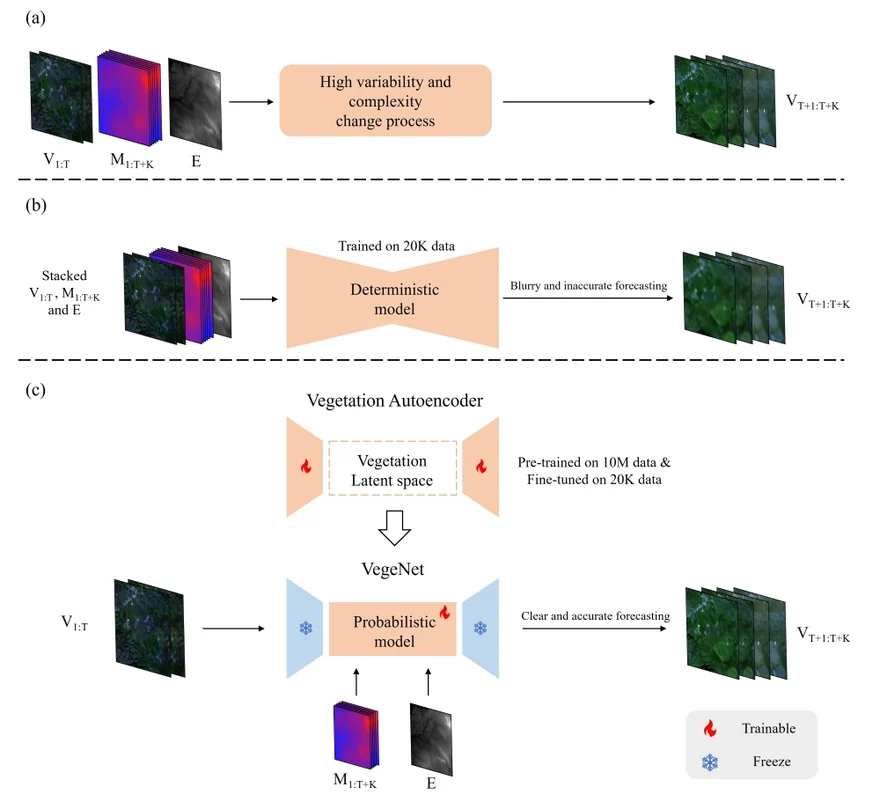
This research introduces VegeDiff to forecast future vegetation states by employing a novel diffusion model to probabilistically capture uncertainties in vegetation change. It accurately models dynamic meteorological and static environmental impacts, providing clear, precise predictions, outperforming existing deterministic methods.
Sijie Zhao, Hao Chen†, Xueliang Zhang†, Pengfeng Xiao, Lei Bai, Wanli Ouyang(† corresponding author)
IEEE Transactions on Geoscience and Remote Sensing (TGRS, SCI Q1 TOP, IF=8.3) 2024 Journal
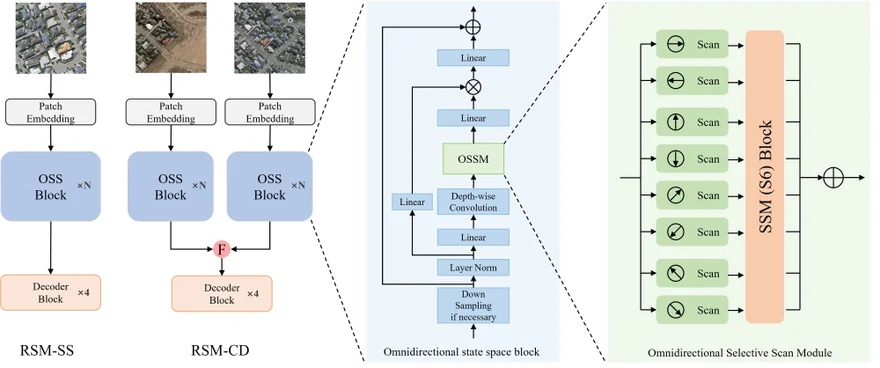
This research introduces Remote Sensing Mamba (RSM) to efficiently model global context in large remote sensing images. RSM overcomes the quadratic complexity of transformers by using an omnidirectional selective scan, achieving state-of-the-art dense prediction performance on VHR images.
Sijie Zhao, Hao Chen†, Xueliang Zhang†, Pengfeng Xiao(† corresponding author)
IEEE Transactions on Geoscience and Remote Sensing (TGRS, SCI Q1 TOP, IF=8.3) 2023 Journal
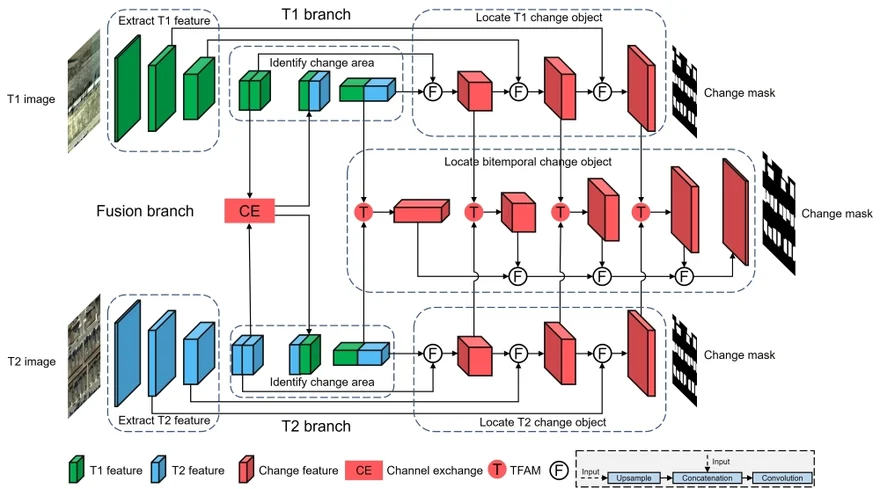
This research introduces a novel exchanging dual encoder-decoder structure for binary change detection. It addresses limitations of existing methods by fusing bitemporal features at the decision level and leveraging bitemporal semantic features. The proposed model achieves superior performance and high efficiency across various change detection scenarios.